

| # | Itinerary | Program |
|---|---|---|
| 1 | Arrival to Paro | Morning arrival to Paro. Visit of Paro dzong, National Museum. Program subject to time of arrival. |
| 2 | Paro – Thimphu | Climb to Taktsang gomba (Tiger’s Nest), is the highlight of the tour. While the hike seems to be hard, it’s very rewarding. You can consider hiking in the morning or early afternoon depending on weather, your fitness and preferences. It will help your acclimatisation to if you climb even above the Tiger's Nest to Zangtopelri lhakhang. There are great views from here to enjoy. Descend down and explore the calm Kyichu lhakhang which also pins down giant demoness body. Drive to castle-ruins of Drukyel dzong, from where you can see the top of holy Jomolhari mountain. Drive to Thimphu in the evening. |
| 3 | Thimphu – Gasa | Morning drive over Dochu-la pass (3115 m). In clear weather get the panoramic views of Snowy Peaks. After lunch in Wangdue or Punakha, continue drive to Gasa. Camp (or stay in local guest house) near Gasa Tsachu, the hot springs. Here you can get the hot bath, the last one for more than two weeks! Tomorrow the serious trekking starts. |
| 4 | Trek Gasa – Takshikha | Trek Distance 12 km, 5-6 h, ➚ 700 m, ➘ 800 m, camp altitude 3350 m. Drive from Gasa over Bari-la pass to the trail head. Road is rough, only good for 4WD vehicles. Once we reach the road end the luggages will be load on horses and we start hiking. Descend through road construction to the Koina station and campsite. You can refresh here and then start ascend over the cliff and again back down to the river. Then continue along the Mo chu river further with some gentle up and downs. You might need to do another tiring up on down in case of high water level. Reach to Takshikha military camp. This place doesn’t get too much sunlight so be prepared for cold. |
| 5 | Halt: Excursion to Laya |
Distance 8 km, 4-5 h, ➚ 600 m, ➘ 600 m. Today we will do acclimatization trip to picturesque Laya village. Climbing 600 meters up will take about 4 hours. Here large village with houses scattered between fields starts. Nice views of surrounding mountains are ubiquitous and local ladies, with their famous antenna hats always ready to stand for photo. We will have traditional lunch in local farmhouse. Then we will visit local temple and walk around the village. If you feel like to continue, you can continue from Laya to Lungu village, which will take another 3-4 hours of good hike. Trail first descends to river before ascending to Lungu (3800 m). Descend back Takshikha military camp and rest.
|
| 6 | Trek Takshikha – Rhoduphu |
Distance 16 km, 6-7 h ➚ 1030 m, ➘ 150 m, camp altitude 4160 m. From Laya we descend to an army camp and continue following the river till the turn off point to Rhoduphu. After lunch the climb continues through rhododendron bushes till you reach the camp at Roduphu just next to the Rhodu Chhu.
|
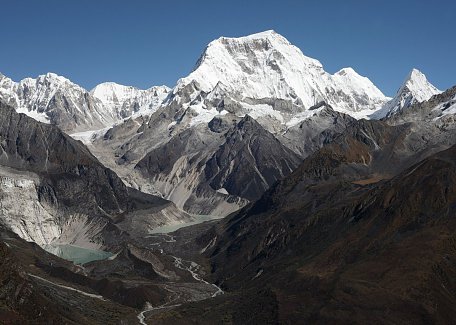
| 7 | Trek Rhodophu – Narethang | 17 km, 7-8 h, ➚ 740 m, camp altitude 4900 m. After following the river for about half an hour you will have a steady climb to a high open valley at 4600 m and then further up to Tsomo La (4900 m). Tsomo La offers a superb view of Lunana, Mount Jomolhari and Jichu Drake, and the Tibetan border. The route then crosses a flat, barren plateau at about 5000 m. The campsite at Narethang is towered by the peak of Gangla Karchung (6395 m). |
| 8 | Trek Narethang – Dead Man’s Camp | 21 km, 6-7 h, ➚ 300 m, ➘ 1200 m, camp altitude 3970 m. From the camp you will climb for about an hour to Gangla Karchung La (5120 m). The view from the pass is breathtaking and the whole range of mountains including Jekangphu Gang (7100 m), Tsenda Kang and Teri Gang (7300 m) can be seen. The pass descends along a large moraine. Again one has great views: a massive glacier descends from Teri Kang to a deep turquoise lake at its foot. Up here a glacial lake burst through its dam in the early 1960s, causing widespread damage and partially destroying Punakha Dzong. Finally, it is a very long descent through thick rhododendron to Tarina valley, where you will find several good campsites along the Tang Chhu. Anyway as this day is not particularly long, you will continue about 1 hour further to large boulder for camping. This place is called “Dead Man’s Camp” by the Bhutanese staff because the tourist did die on this place due to high altitude sickness. You should be having good acclimatization though, so have no worry. Your Bhutanese staff might be afraid of ghost though! |
| 9 | Trek Dead Man’s Camp – Woche Chhu | 15 km, 4-5 h, ➚ 240 m, ➘ 330 m, camp altitude 3910 m. The walk leads down through conifer forests following the upper ridges of the Pho Chhu, passing some impressive waterfalls. The trail then climbs over a ridge and drops to Woche after about 2.5-hour walk. This is settlement of a few houses, the first village in the Lunana region. The trail leading south-west is the fastest way to reach Punakha valley and is used by locals when they need to go to “civilization”. Spend some time to explore the village or visit a local shop. Afternoon continue some 1.5 hour the campsite by the Woche Chhu river side. |
| 10 | Trek Woche Chhu – Lhedi | 16 km, 7-8 h, ➚ 980 m, ➘ 1190 m, camp altitude 3700 m. This will be quite hard and long day. The trek starts through juniper and fir forests, and further ahead, through rhododendron bushes. Climb up to Keche La pass (4650 m) where one can have the great view of surrounding mountains again. After the pass, descend to the riverside walking through a village with a stunning view of Table Mountain and others. Follow up the river till Lhedi Village. Lhedi has a basic health unit and a school. Camp by the village. |
| 11 | Trek Lhedi – Thanza | 14 km, 6-7 h, ➚ 450 m, camp altitude 4150 m. In clear weather, you will have great views of Table Mountain (7100 m). Around lunchtime, you will pass the small village of Chozo (4090 m) which has a dzong still in use. Reaching Thanza again you will have a great view of Table Mountain which forms a 3000 m high wall of snow and ice behind the village. Although there are possibilities to camp directly at Thanza, most groups prefer to camp in Thoencha. |
| 12 | Halt in Thanza | Rest day in Thanza. You can either get well deserved rest after very difficult part of the trek of make about 1-2 hours hike to neighboring villages. Other option is the viewpoint in 4800 m with the views of the surrounding mountains. Thanza has mobile phone network and even the data connection, so you can check your e-mails and update social networks. |
| 13 | Trek Thanza – Tshorim | 8-9 h, camp altitude 5240 m. Having chosen the route to Bumthang the trek starts by climbing a ridge with a great view of Table Mountain and Thanza valley below. The ridge altitude is 4500 m, and it rises gradually up to 4650 m. After lunch, walk upwards towards the left side of the bridge to enjoy the view of snow-capped mountains. You reach the campsite of Tshorim after climbing more ridges. This is the highest campsite of the trek. |
| 14 | Trek Tshorim – Geshe Wom | 7-8 h, camp altitude 4400 m.This is one of the highlights of the trek and the day starts with a short climb to the Tshorim Tsho lake, one of the most spectacular mountain lakes of Bhutan. You walk on the side of the lake enjoying a panoramic view of the Gophu La ranges. The last climb to the Gophu La pass (5455 m) is not long. After the pass descend to the Zanam campsite, walking along the ridge to enjoy a great view of Gangkhar Puensum. We will not camp here though and will continue walking for another two hours for another good camping place by Sha Chhu, making next day long stretch much more feasible. |
| 15 | Geshe Wom – Warathang | 7-8 h, camp altitude 4500 m. The trail further follows the Sha Chhu and descends gradually to Minchungang (4200 m). Here the very steep climb starts which will take you Phrodhrang La pass (4660 m). Below that, there is high campsite called Phrodhrang, which used by parties trekking in opposite way. Continue descending until you start again climbing to Sake La pass (4950 m) reaching to summit approximately 2 hours after first pass. From here it’s about one hour to descend to Warathang (4520 m). |
| 16 | Trek Warathang – Duer Tsachu | 4-5 h, camp altitude 3350 m. Day starts with the short climb to Urathagn la (4600 m). After the pass, you have to undertake long and uncomfortable descend to the riverside through dense rhododendron, juniper, and conifer forest. After the bridge a short climb leads to Duer Tsachu. These hot springs, where Guru Padmasambhava is supposed to have taken bath, might be the most stunningly beautiful hot springs of the Himalayas. You will enjoy the afternoon bath to clean the sweat of previous days! |
| 17 | Trek Duer Tsachu – Tshochenchen | 15 km, 8-9 h, ➚ 1500 m, ➘ 700 m, camp altitude 4150 m. Refreshed in hot springs, you begin last major climb of the trek. Mixed forest is changing to juniper one. It will take about 3-4 hours to reach the Gokthong-la pass (4420 m). Descend below the pass and have lunch. After that, you will need to undertake 1.5 hour climb the Juli La pass (4700 m). This is good time to small celebration as it’s the last pass of the trek! Finally descend to the beautiful Tshochenchen campsite by the small stream. |
| 18 | Trek Tshochenchen – Gorsum | 6-7 h, ➚ 100 m, ➘ 950 m, camp altitude 3200 m. Follow the stream all day, reaching to mixed forest of junipers and rhododendrons. Last camp at Gorsum after last serious trekking day. |
| 19 | Trek Gorsum – Duer, drive to Jakar | 3 h, ➘ 700 m. Continue descending through mixed pine forest until you reach road head at Dur village. Here the bus will be waiting you! Enjoy the refreshments, and tell proper goodbye to your trekking staff. Then drive to Jakar and accommodate in the hotel after 24 days trekking! |
| 20 | Rest in Jakar | Enjoying the end of trek in beautiful valley of Bumthang. Easy sightseeing around and visiting temples like Jambey, Lhakhang, Kurjey and Tamshing. Visit to Red Panda brewery with beer tasting. Explore lively little town of Jakar. |
| 21 | Jakar – Wangdue / Punakha | In the early morning start drive back to the west. First reach to Chummey where you can stop for traditional textile shopping. After crossing Yotung-la pass (3400 m) descend to Trongsa. Here you will visit one of the largest castles, called dzong, in Bhutan. From here, the royal family of Bhutan had risen. Continue long drive on windy road with short stop at Chendebji stupa, which is designed after Bouddhanath stupa of Kathmandu. Reach to Pele-la pass (3450 m) which is the border of central and western Bhutan. Finally descend to subtropical Wangdue valley, reaching there by the evening. |
| 22 | Wangdue / Punakha – Paro | Morning climb to Khamsum monastery with wonderful view of the valley, and it's terraced paddy fields. See the longest suspension bridge in Bhutan stretching the length of 350 m over Pho Chhu river. Visit of Punakha dzong, which counts as the most intricately decorated castle in the kingdom. Short walk to Chhimmy lhakhang temple, devoted to 15th century saint Drukpa Kunley, known as “Divine madman”, who taught Buddhism by singing, drinking and rampant sexual behavior. If time permits, also visit Sangchhen Dorji Lhuendrup Lhakhang nunnery with Bhutanese and Nepali style stupa, overlooking the valley from the high hill. Afternoon drive to Thimphu. Walk in town and enjoy the last day in Bhutan. |
| 23 | Departure from Bhutan | Drop to Paro airport and departure from Bhutan. |
Tour variants, extensions and combinations:
- Full classical Snowman Trek with start in Paro (total 30 days): While starting in Paro results in longer trek, it's easier due to mild acclimatiozation on the beginning of the trek. See Snowman Trek itinerary for details.
- Extra days for cultural sightseeing (1 or more days): Apart from trekking, you also want to visit major sights of Bhutan? Extend your trip with longer stay in Jakar, Trongsa, Phobjikha, Punakha, Thimphu and more. Inquire for options.